I’m a moderate/centrist, I guess. And I like to think of myself as a political Independent, or just unaffiliated. I’m not really a democrat nor a republican, at this time.. I see it both ways, and both viewpoints are valid, actually. I see truths throughout all shades of the political spectrum.
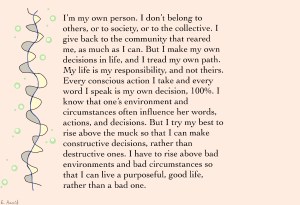
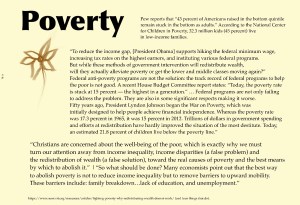
I think that giving the disadvantaged people enough money and resources, financial help and social support, will solve most of the poverty in America. It’s so solvable; no one denies that it’s very solvable. And I’ve studied a little bit about negative income tax (which is a form of redistribution), and I’ve understood that it’s one of the more efficient and effective ways to end poverty and help people get onto the right track in life, upwards and onwards. We all have to work; and we have to keep going; and we have to give every day our best effort.. Individual effort meets societal help; they’re not mutually exclusive. Personal responsibility and collective responsibility; they’re not mutually exclusive.
As for “everything should be paid for by the rich”—free medical care/health insurance; free housing; free daycare; free college; free groceries; free everything—this idea doesn’t work, I think? We run out of money, at some point in the future. All of those products and services cost money. Even with the trillions that the rich currently have; we start to run out of money, sooner or later, when they have to cover all these expenses for everyone. From what I understand; we have to get working and make our own way. We shouldn’t expect others, “the rich,” to pay for us… And even if they do pay for us for some time, and throughout certain areas of life—we should still try to become self-sufficient so as to not be a drain on the system. That’s the harsh reality of life, I guess..
And money doesn’t grow on trees, I guess. I know that the government has a printer, and they can just print as much money as they want. But doesn’t this de-value the currency, the dollars that are already in circulation? If printing more money was the solution to poverty; then why didn’t we just print out a bunch of money, and give it to everyone, a long time ago? Problem would have been solved, long ago. But I guess it’s not that easy, or something…
We should do a lot more to end poverty and stuff like that…we can end it. Best solution is jobs, opportunity creation, and worker-friendly and business-friendly environments—ones that are not stifled by overregulation and heavy taxation. Lower taxes helps businesses save revenue, which can then be given to the employees, and used to hire and pay new employees, and etc. And it helps businesses reinvest, grow, and develop.
And places like Starbucks, McDonald’s, Amazon, and Walmart can probably afford a high wage for every employee, everyone who works there. But small/er companies on main street can’t… They’d have to lay off workers, or not hire as many people, in order to comply with high minimum wage laws.. And you know, it prices people out of the market—people who are just starting out, and who don’t have much experience or skills yet. High minimum wage laws make it harder for these folks to find work. It’s better for as many people as possible to get their foot on the first rung of the economic ladder, even if the initial compensation isn’t high—than is a high minimum wage for the select few, the people fortunate enough to get hired in the first place.
And the solution to poverty in *Africa,* is the same as it is in America; jobs, industry, industrialization, opportunity creation, economic growth, upward mobility, trade, innovation, free markets, etc. etc. I’m from Sudan, in northeast Africa, and so this topic means a lot to me, this topic of poverty eradication and prosperity-building.
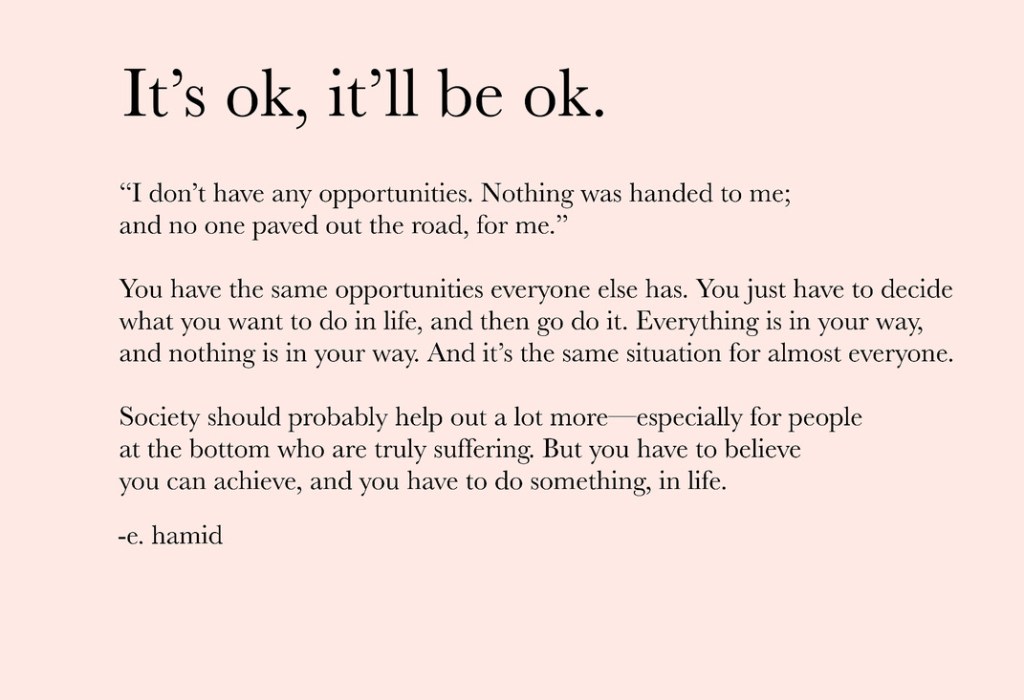
It turns out that capitalism is the main way out of poverty. I’m not saying social welfare isn’t necessary. We need way more of that—especially for people at the bottom who are truly suffering. But this doesn’t cure poverty, it only alleviates it. The cure, the true eradication, is capitalism—and the self-sufficiency, self-reliance, and financial stability that comes along with it. These aims are not the easiest things to achieve, but we can do it.
And we should help each other out a lot more—but the ultimate goal is to help one another attain self-sufficiency. “The rich” aren’t responsible for everyone.. They should give as much as possible, since they don’t need all that much money. And they should give to education, to cancer research, to children’s charities, etc. etc. And at the same time, you and I have to try, as well. We have to try to make our own way. We’re perfectly capable.
And all the vulnerable peoples are all exempt to a great extent, of course: disabled people; chronically sick people; stay at home parents; the children; the elderly/retirees; people who have bad prospects in life, for some reason; people who have been dealt a bad hand; troubled people; etc. etc. These vulnerable peoples should all be protected and supported, of course. It’s a moral obligation..
And there should be social welfare for people who cannot afford life’s basic necessities. Medicaid (health insurance); SNAP, and food access; financial aid for college; child care discounts and coverage; subsidized housing/public housing; utility bills assistance; etc. etc. All of these programs and services are available on an as-needed basis, of course. I’m not really sure what the purpose of universal coverage is, across all of these areas. Why give the affluent and the well-off people, free stuff? So I haven’t quite understood the point of universal coverage for all these necessities of life. If you can afford to pay for these essential goods and services, then you probably should. Otherwise, it would just be on the very rich to pay for the whole of society. “Free goods and services—government-subsidized goods and services”–actually means “paid for by the rich, the very rich in society. The top 10%, or so.” Nothing is free. Workers have to get compensated/paid for providing all those goods and services to society, after all. People can’t work for free, the whole time. And so we can’t expect free goods/services, I guess. People always have to get paid. And someone’s paying the bill, always. The rich pay.
*All taxpayers pay for these programs, to some extent…But the wealthy pay most of it, I think, since they pay the bulk of the taxes that are collected by the government. The wealthy pay for most of these programs. *And social welfare is something we should try to get out of, eventually. We don’t wanna be on the dole, in any way at all. I believe in self-sufficiency, being financially stable, and being independently wealthy enough, without help from the government or charitable organizations. I believe in financial stability, without any dependence on the government or charitable organizations. The only system that lets you do this is capitalism/free enterprise/job creation/wealth production/earning income. And so I believe in capitalism, just as much as I believe in social welfare for people who can’t make it and who need ongoing help. E.g., the disabled; people stuck in generational poverty; folks who have had bad lives and can’t care for themselves; and so on.
As for the cash assistance, government welfare benefits, charitable donations, and free, charitable services (like free clinics; food pantries; free personal development classes, etc. etc.); give that to people who truly need it. Some families really are struggling, and they could use these resources and supports… *I, for one, do not need that. I’m capable, strong, hardworking, and I can make it on my own. I don’t need social welfare benefits, to survive. Just give it to someone who needs it… And I can do it by myself, I don’t need any help. -This is my own understanding and worldview regarding this issue of socioeconomics, social welfare, and etc…
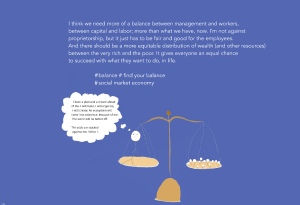
*And, as for those business owners who make quite a lot of money; I think we should redistribute some of that money, to the people in society who really need it.. I mean I know that some people think this money should be given to the employees of the companies.. The only problem I see with this is that; the people working at these companies come from a variety of different financial backgrounds, almost definitely.. For some, this job will be their very first job—they’re still young, and are living with their families. They don’t have any bills to pay yet, or anything.. They’re just working to gain experience//get their foot in the door. And same thing with spouses who are working for extra income, for their households.. They don’t necessarily need a high wage/salary.. And same thing with employees who live with family, or who rent with with roommates, or something like that…A high wage isn’t quite necessary, for them.
So that’s why I don’t really believe in a high minimum wage…and I don’t really advocate for a lesser gap between the CEOs and the workers.. *I just simply believe in redistributing money to people who need it…poor people, disadvantaged people, etc. This will ensure that, without a doubt, poorer people have enough to live on, and then some… And the money is only (re)distributed to the addresses that need it. The government redistributes to the addresses that need it, to the people that need it. And it doesn’t quite matter where the financial help//money comes from, at the end of the day… whether from the employer, through high(er) wages—or through the government, via benefits/financial help. But, redistributing through the government makes much more sense, I think…it makes more sense than mandating a high minimum wage from the employers…or mandating ‘closing the pay gap between employers and employees.’ **And, some people aren’t even employed! So how can they receive this pay bump? They’re unemployed, right now. So by all means, I think government redistribution—or a negative income tax, as aforementioned—can solve the issue of poverty and financial hardship in America, to a great extent…
In terms of capitalism; a lot of people think it’s bad and evil. From what I understand, all “capitalism” is, is business ownership, and stuff like that. The individual right to start and own a business, or a piece of land, property, etc. And I tend to think this is quite fabulous, to be honest. I truly love the freedom to be the master of one’s fate and the captain of one’s soul. I think freedom to rise up and make a lot of honest money, is fabulous. But I think people should be as generous as they possibly can, of course. And this includes redistribution of money; and lots of resources and financial help for the less fortunate; and etc. So, I believe in helping the poor; but I don’t believe in tearing down the rich. The reason why I don’t believe in tearing down the rich is because they earned their money fairly… Just like you and I go to work and earn a paycheck, they also earned their money fairly. They didn’t cheat or exploit anyone, not even for one dollar. And as long as they’re very generous, and stuff like that…philanthropy, giving away a lot of their wealth, and etc. They usually give up their wealth to charitable causes and to organizations that help people who truly are in need, people at the very bottom who have no means of rising up by themselves. So I guess I’m inclined to believe in social capitalism, with lots of emphasis on the “social” part of it.. And a mixed economy, an expanded welfare state, and etc..
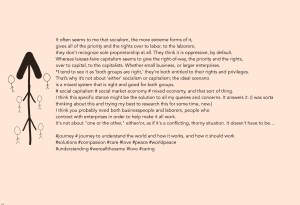
Third-way economics, I think it’s sometimes called. In respects to socialism, third-way shares many similarities; but it has several important differences, at the same time.. And in regards to capitalism, third-way economics (or social capitalism; a social market economy, regulated market economy, etc. etc.) permits business ownership, private property rights, and etc., because it’s recognized as a way to build personal wealth, and stuff like that…and it’s an individual right, part of personal freedoms. **But there’s tons of concern for the poor, and for people who have bad lives/bad chances for success.. *And everyone is expected to succeed on their own, and take good care of themselves, once a social safety net and a strong welfare state is adequately provided. Third-way doesn’t seek to equalize everyone, or anything like that.. and it doesn’t seek to do away with capitalism, business ownership, etc. Why? Well, it’s because the wealth was earned fairly; it wasn’t stolen or exploited from people.. and 2. This wealth can be put to some good use, in the society. Instead of ‘equalizing the wealth among everyone in the society’; why not fund actual causes, like cancer research, education, children’s wellbeing; endowments for universities; climate protection initiatives; and etc., etc.? When people say “the excess money, the profits, should be given to everyone, equally—cashed out evenly amongst the population”—I don’t know if this is accurate, or morally correct. We all have to make money individually, anyways..through our work.. And if we’re struggling, there ought to be a really strong welfare state (along with local charities, nonprofit organizations, etc. etc.) to help us back up again..
I mean, I’m not sure what people are after, other than a welfare state. There already is some financial assistance, and many free services, like medicaid insurance, snap, food access, etc. etc., from the government.. Perhaps we should greatly expand upon these already-existing services… And maybe add in a negative income tax. And this gets rid of poverty and financial strain. It’s for people who need it.. Maybe as much as the bottom 40% or so of the population will end up using these benefits, at least to some extent..
So, it’s called welfare, an expanded welfare state. I don’t think anything beyond this, is gonna fly, if you know what I mean.. Life is both give and take, I guess.. It’s based on working, upward mobility//moving up the socioeconomic ladder, saving, investing, etc. etc.; and receiving social welfare whenever necessary. Individual effort and financial help//social welfare. It’s not either/or. And so I agree with both “the traditional left” and “the traditional right,” I guess.
And this is what I honestly believe, at the moment…alhamdulillah… Who knows though, I might be all wrong…
Jazakum Allahu kheira, god bless everyone.. —-e.